Could a national insurance program protect your land trust against legal action and free up more money for land stewardship and acquisition? We need your input.
Across Canada, 150+ land trusts and other conservation organizations safeguard critical ecosystems in perpetuity, protecting nature and helping the country meet its ambitious biodiversity goals.
“That’s a big commitment,” says Bob McLean, policy director for the Centre for Land Conservation (CLC). “A lot can happen over forever.”
The possibilities include legal issues. Trespassers who cut trees or create roads. Encroachment and boundary disputes. Title challenges. A new landowner contesting an existing conservation agreement.
And on and on.
A 2023 survey by CLC underscores the scale of the issue. Nearly half (45 per cent) of the land trusts that responded told us they’ve already faced legal issues to defend their lands or agreements.
Notably, more than half of lands they hold are protected through conservation agreements with property owners. (Depending on where you are in Canada, these may be referred to as easements, servitudes or covenants.)
These types of arrangements create greater legal exposure compared to land owned directly by the land trust — especially when deeds change hands and new owners are unfamiliar with or opposed to the restrictions attached to their property.
Organizations have no way of knowing when they will need to litigate to protect a conservation agreement or conserved property, how long negotiation and litigation may take or how much it may cost.
High costs, limited safety nets
When disputes arise, the costs can be crippling. Legal fees, expert witnesses, mediation and court costs can quickly hit six figures. For land conservation organizations — which already run on a shoestring budget — these expenses aren’t insurable through liability insurance or title insurance. Instead, they must be paid from operating budgets or restricted funds.
This means land trusts are forced to choose between setting aside funds for potential legal challenges in the future or investing in conservation today. Currently, however, most organizations lack enough funds in their legal war chest to defend a conservation agreement or land that they own.
Moreover, some organizations are not using conservation agreements because of concern about higher legal risks, thus slowing conservation progress.
But the dangers don’t end there. “This could be a Pandora’s box,” says McLean. “The big fear in this situation is that when you lose a case, it has a potential to set precedent for other cases like that in the future. So the idea is everybody has to be equally strong.”
Most organizations lack enough funds to cover the cost of defending land that they own or is protected through a conservation agreement.
The risk of legal challenges may also discourage donors from stepping up. “Being able to say this land is also protected through a conservation insurance program against any legal actions adds to the confidence that a major donor might need in giving a gift of land or money,” McLean points out.
Creating a collective insurance fund for legal defence
That’s why CLC is exploring the benefits of creating an insurance program designed by and for Canadian land conservation organizations, where the members pool resources to insure each another against legal risks.
This reciprocal approach would allow coverage to be tailored specifically to conservation defence, including the legal costs of enforcing conservation agreements or defending freehold lands. It could also prove economical because it is owned and governed by its members, not by a company set up to generate profits.
The proposed program would draw on successful models elsewhere, including the Terrafirma program that currently insures hundreds of land trusts across the U.S. for costs of defending their lands and agreements.
The benefits of a national conservation defence insurance program 1) Financial protection against legal costs, including lawyer fees, court costs, expert witnesses, mediation and settlement expenses 2) Better organizational preparedness, giving land trusts clear guidance on best practices for looking after land, keeping good records and managing risks responsibly 3) Enhanced donor and funder confidence and ability to recruit board members 4) A deterrent effect on potential challengers
Take the current survey — Help shape a program that works for you
Before we start creating a reciprocal insurance program, we need good data. That’s why CLC is currently conducting a sector-wide survey. We want to identify the common risks that land trusts face, how frequently legal incidents arise and the costs of legal defence in in terms of both money and staff and volunteer time.
An advisory group will use this data to develop a draft insurance policy, including recommendations on annual premium rates, coverage and initial capitalization needs. This draft policy would be the basis for a consultation to gauge organizational interest in subscribing to the insurance.
In Canada, private land conservation organizations steward hundreds of thousands of hectares of land and hold $2.6 billion in assets. It’s a huge responsibility that requires the financial capacity to respond to legal actions.
According to the survey responses we’ve already received, organizations have already faced more than 100 legal incidents since 2015.
A national conservation defence insurance program could be a proactive, practical way to strengthen the sector’s collective ability to do that. And your input will shape how it would be structured and governed.
If you haven’t already responded, we would greatly appreciate your input. The more data, the better!
Thinking Bigger and Bolder: the Ivey Conservation Leadership Program
Canada’s land trust leaders have daunting job descriptions. Steward hundreds or thousands of hectares of land in perpetuity. Run their organization on a shoestring budget. Raise money. Negotiate land agreements. Manage staff and volunteers. All in a high-stakes mission to fight biodiversity loss and preserve ecosystems under threat.
While many of them bring stellar backgrounds in biology or environmental science, most lack any formal leadership training.
The Conservation Leadership Program aims to fill that void. The initiative was co-created by the Centre for Land Conservation (CLC) and the Ivey School of Business at Ontario’s Western University, with support from Metcalf Foundation and the Chisholm Thomson Family Foundation.
The five-day program doesn’t provide cookie-cutter executive training. Instead, it was specifically designed to empower senior land trust leaders with the business skills, approaches, tools and networks to deliver system-wide change.
“By working with Ivey, we’re bringing proven leadership development into the land conservation sector,” says CLC Executive Director Lara Ellis. “These leaders already have the passion and knowledge. Now this program helps them amplify their impact.”
Cultivating confident, effective change-makers
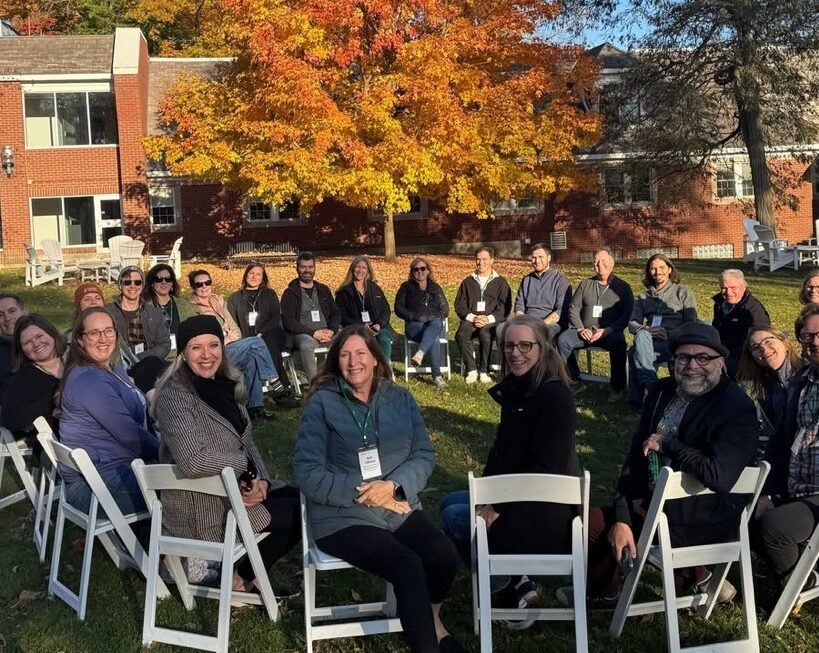
In October 2025, the program welcomed its inaugural cohort of 24 participants, representing land conservation organizations large and small from across the country.
Together, they explored different dimensions of leadership through case studies, hands-on exercises and coaching-style facilitation. Led by Ivey faculty and conservation experts, they sharpened their strategic thinking, strengthened negotiation and collaboration skills and developed the entrepreneurial mindset required to scale up the impact of land conservation across Canada.
“I feel like finally I have some formal training in the things that are expected of me as an executive director,” says Calder Schweitzer, who has headed up Ontario’s Thousand Islands Watershed Land Trust for the past six years.
For newcomers to the world of land trusts, it offered a deep dive into the sector. “There were so many aspects of it that were extremely rich and phenomenal learning opportunities,” says Amy Kamarainen, who had been appointed executive director of B.C.’s Mayne Island Conservancy just a few months prior to arriving at Ivey.
But the program proved just as valuable for seasoned leaders like Jasper Lament, who has served as CEO of the Nature Trust of British Columbia — the province’s biggest regional land trust — since 2012.
“I think really all land trusts that are on a growth trajectory or want to be on a growth trajectory can benefit,” he says. “It’s a unique opportunity for land trust leaders to learn from some of the best business school instructors in Canada and bring those lessons back to their organizations.”
His classmates agree, giving the program an overall rating of 6.9 out of 7.
Strengthening networks and enhancing capacity
Highlights included simulated negotiations, hands-on sales exercises and a session on Two-Eyed Seeing approaches that braid together Indigenous and Western teachings. “That’s something that all of us in the sector have to build our skills and understanding about,” says Lament.
Perhaps the greatest benefit was connecting with peers across Canada who understand the pressures and complexities of the work and are navigating many of the same challenges. By providing space to build strong personal relationships, the program has created a network of leaders who feel comfortable asking each other questions, sharing knowledge and comparing notes.
“It no longer feels like I’m the [only] one working on this,” says Schweitzer. “There are tons and tons of people working on what I see is the big problem of our time, and that really inspires a lot of hope. It re-energizes me for the work.”
According to Kamarainen, coming together also revealed opportunities to work together and take conservation to a new level. “We see those leverage points in the system that can help us really push for change,” she says. “I think it could lead to some really amazing things.”
An investment that pays dividends
Stepping away for a full week represents a significant commitment of both time and money. However, substantial subsidies helped make the program accessible, thanks to generous funding from the Metcalf Foundation and the Chisholm Thomson Family Foundation.
Lament sees big value in having the space to focus on bigger-picture issues that shape long-term organizational success. “I think that’s an investment that will pay dividends for land trusts across Canada,” he says.
It comes at a pivotal time. In the face of climate change and biodiversity loss — and in the midst of growing geopolitical and economic uncertainty — conservation professionals need the tools to overcome obstacles, drive change and achieve lasting results.
“The future of Canada’s lands depends on the people leading their protection,” says Ellis. “I think that any leader that has the opportunity to do the course should jump in with both feet.”
Canada can’t meet its 30×30 conservation target without private landowners
Many private properties conserve wildlife habitat and other crucial ecological services. Our new report explores how to count those contributions — and encourage more.
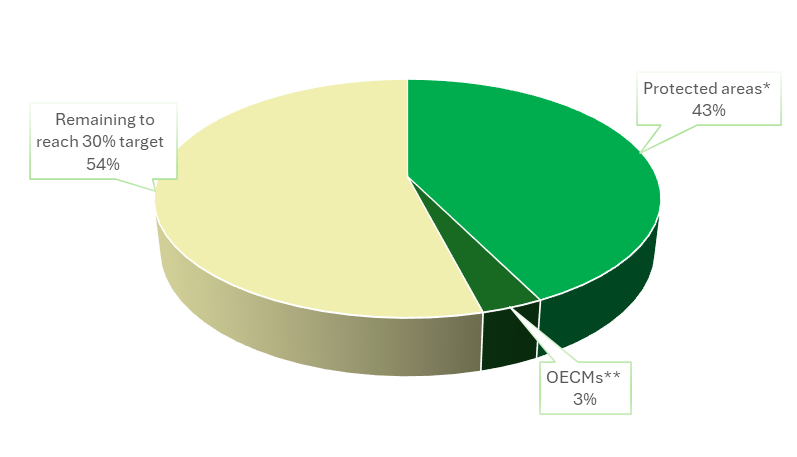
Today, up to a million species around the world teeter on extinction. To tackle that biodiversity crisis, 196 countries, including Canada, have committed to 30×30: conserving 30 per cent of their land and freshwater by 2030.
At the end of 2024, Canada had conserved nearly 14 per cent, primarily through federal, provincial and territorial parks and Indigenous-protected areas. But those actions alone won’t be enough to achieve the goal.
That’s why the 30×30 strategy also recognizes the importance of other effective conservation measures (OECMs): spaces that conserve biodiversity but don’t meet the formal definition of a protected area.
Recognizing landowner efforts
OECMs are especially important in conserving Canada’s southern landscapes, where most land is privately owned and where biodiversity loss is the highest.
The good news is that many privately owned agricultural and forested properties across the country already meet the criteria for OECMs — or would meet them with some minor changes.
Many privately owned properties already meet the criteria for OECMs — but those contributions aren’t being counted
“Many landowners are stewards of important ecosystems that provide all kinds of benefits,” explains Bob McLean, Director of Policy for the Centre for Land Conservation (CLC). “Their grassland pastures support birds and pollinators. Their wetlands purify water, absorb carbon and mitigate flooding. And their woodlots offer crucial wildlife habitat.”
But in most cases, those contributions aren’t being counted.The Canadian Protected and Conserved Areas Database includes more than 1,280,000 square kilometres of protected terrestrial areas, but only 92,753 square kilometres of OECMs.
Canada’s progress towards its 30×30 conservation targets
* Includes national, provincial and territorial parks, Indigenous protected areas, national wildlife areas and migratory bird sanctuaries
** Areas that conserve biodiversity over the long term but don’t meet the formal definition of a protected area
So CLC set out to understand why many OECM-eligible agricultural and woodlot lands have yet to be counted as part of Canada’s official conservation network — and what could be done to encourage more landowners to step up their stewardship activities.
We found landowners aren’t stepping up to have their conservation efforts counted because the effort is too great and the rewards too few.Our report pinpoints three key concerns.
Landowners aren’t stepping up to have their conservation efforts counted because the effort is too great and the rewards too few
Identifying key barriers
Loss of autonomy and privacy
Concerns about privacy and autonomy are among the main reasons why even the most conservation-minded landowners hesitate to pursue OECM recognition. Many fear that publicly disclosing their conservation activities could lead to unwanted attention, trespassing, government oversight or new restrictions on how they can use their own land.
As one focus group participant put it, “Once your land is publicly recognized for conservation, people might think it’s like a park — they don’t understand that it’s still private. They will start showing up to visit or do recreational activities, and that’s not what we signed up for.”
Changing the OECM model to keep landowner information private would go a long way in bringing more landowners on board.
“Once your land is publicly recognized for conservation, people might think it’s like a park”
A burdensome process
Another barrier is that the work of navigating the process rests entirely on landowners. That’s where pivoting to an “opt-out” model could make a big difference. Instead of requiring landowners to initiate the process, owners of ecologically valuable lands could be notified that their property will be included in the OECM tally unless they actively decline.
Designing participation around default enrollment — while maintaining autonomy and transparency — could unlock broader participation.
Lack of incentives
Finally, conservation often comes with costs. A farmer who opts to leave a section of their property forested has less land for crops — and less income as a consequence. Financial incentives help landowners offset that loss.
That’s why it’s critical to offer incentive programs such as tax breaks, annual payments for ecosystem services and market-based programs like carbon and biodiversity credits.
Leveraging trusted third parties
A number of conservation and stewardship organizations are well placed to communicate and build trusted relationships with landowners. These include local land trusts, agricultural producer associations and woodlot management associations. They can help evaluate sites, provide technical assistance, deliver incentives and navigate the complex landscape of conservation tools and reporting processes.
“Organizations like ours can play a big role in bringing more privately owned lands into Canada’s conservation network,” says Bryan Gilvesy, Chief Strategy Officer of ALUS, which helps farmers and ranchers create nature-based solutions on their property. “We work side by side with landowners to further conservation every day, so we understand their values, their motivations and their realities.”
Conservation and stewardship organizations can play a big role in bringing more privately owned lands into Canada’s conservation network
Nine win-win recommendations
Based on those insights, our report offers policymakers nine recommendations to count more privately conserved agricultural and woodlot landstowards Canada’s 30×30 targets:
Scale up and sustain conservation incentive programs.
Share the cost of conservation on private working lands.
Explore “safe harbour” or similar agreements that assure landowners their conservation actions won’t lead to future land-use restrictions.
Strengthen the capacity of organizations that engage directly with landowners.
Explore mechanisms that enable organizations to establish and maintain connections with landowners (e.g., building a digital platform that connects landowners with conservation organizations, technical experts, funding programs and peer networks).
Enhance privacy by enabling self-determined levels of information disclosure and/or aggregated or batch reporting of lands as OECMs.
Empower qualified third parties to accept OECMs into the Canadian Protected and Conserved Areas Database.
Interpret OECM guidance with a focus on outcomes from land management practices (e.g., allowing farm management plans as evidence of long-term commitments to conservation).
Consider proactive engagement with landowners (e.g., moving to a voluntary opt-out model).
The result is a win for landowners, addressing their legitimate concerns and providing more incentives to engage in environmental stewardship. It’s a win for Canada, moving the country closer to its 30×30 target. And it’s a win for biodiversity, especially in southern Canada where species face the greatest threats.
“Canada needs to pull out all the stops to tackle the biodiversity crisis,” says CLC Executive Director Lara Ellis. “That includes recognizing and supporting landowners as key partners and empowering organizations to help them implement and enhance conservation practices.”
As a national organization established in 2019, the Centre for Land Conservation (CLC) advances land conservation and stewardship through certification, policy and research
Centre for Land Conservation Featured in CPA Canada’s Pivot Magazine
We’re pleased to share that the Centre for Land Conservation is highlighted in the latest issue of Pivot magazine, published by CPA Canada. In her article “Safeguarding Green Spaces,” Natasha van Bentum, a former outreach adviser for Environment and Climate Change Canada’s Ecological Gifts Program, discusses how financial and legal advisers can collaborate effectively with land trusts to help conservation-minded clients protect their properties in perpetuity. The article features CLC’s role in advancing respectful conservation and stewardship through collaboration and innovation and references our work maintaining the Canadian Land Trust Standards and Practices—the ethical and technical guidelines that underpin responsible land trust operations across Canada. This important piece helps bridge the gap between professional advisers and the land trust sector, ensuring more Canadians can successfully contribute to conservation efforts.
“At Centre for Land Conservation, we see this as a critical investment in the future of land conservation in Canada. By working with Ivey, we’re bringing proven leadership development into a sector where it’s urgently needed. These leaders already have the passion and knowledge. Now this program helps them amplify their impact. The future of Canada’s lands depends on the people leading their protection.”
– Lara Ellis, Executive Director at Centre for Land Conservation
Supported by Founding Partners, the Metcalf Foundation and the Chisholm Thomson Family Foundation, the program blends Ivey’s top-ranked executive training with sector expertise to equip leaders with the skills and confidence to lead boldly and drive greater impact across Canada. It equips experienced professionals with the tools, perspective, and peer support needed to lead boldly and drive real results in a time of escalating environmental risk.
How a new certification program promises to enhance the credibility and impact of land conservation organizations across the country — and benefit all Canadians
There’s a lot riding on Canada’s 150+ local and regional land conservation organizations. These not-for-profits are protecting more than a million hectares of forests, farmland, wetlands, grasslands and other natural spaces across the country.
It’s crucial work, according to Lara Ellis, executive director of the Centre for Land Conservation (CLC). “They’re safeguarding habitat for our country’s wildlife, building our resilience to climate change and preserving greenspaces where we connect and play,” she says. “That’s particularly important in southern Canada, where most land is privately owned.”
These organizations are negotiating significant legal agreements. They’re securing millions of dollars of land, either through direct purchase, donation or conservation agreements. They’re raising substantial amounts of money, not only for purchasing properties but for the endowment funds needed to steward that land in perpetuity. And while some have professional staff, many are run entirely by volunteers.
To do all that, organizations need the confidence of donors and landowners. “The trust of our donors is the biggest asset we have,” says Dorthea Hangaard, executive director of the Couchiching Conservancy, which stewards more than 6,000 hectares of land in central Ontario.
That’s where CLC’s new Conservation Excellence Certification promises to make a big impact.
Recognizing conservation excellence
The voluntary program recognizes local and regional land conservation organizations that undergo a rigorous assessment process to prove they meet the highest standards of transparency, accountability and impact.
Now CLC is proud to salute the first six organizations to achieve certification, officially announced on March 20, 2025:
The Southern Interior Land Trust Society in B.C.
The Nature Trust of New Brunswick
The Couchiching Conservancy,
Haliburton Highlands Land Trust
The Kawartha Land Trust
The Ontario Farmland Trust
For Ellis, it was a watershed moment. “This marks the beginning of a new era of land conservation in Canada,” she says. “I believe our Conservation Excellence Certification program will drive more support than ever for land trusts across the country.”
Judie Steeves, president of B.C.’s Southern Interior Land Trust, agrees. “This recognition will help us build stronger partnerships and secure more habitat for wildlife,” she says. To date, the entirely volunteer-run group has purchased, protected and restored hundreds of hectares of Okanagan wilderness.
“This recognition will help us build stronger partnerships and secure more habitat for wildlife”
Certification pays big dividends
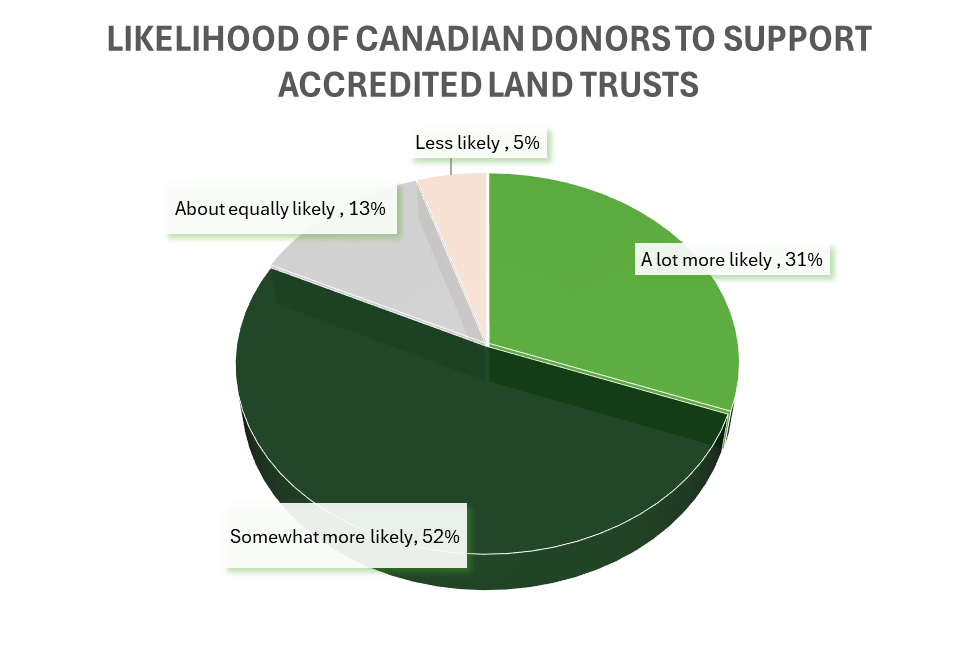
There’s solid data to back up those beliefs. In 2024, CLC commissioned an independent survey of more than 400 Canadians across the country who had donated to charity in the previous two years.
Although a large majority said they trusted charities, nine out of 10 would put more confidence and trust in an organization accredited by a third party. More than 80 per cent believe that CLC’s program would help achieve the goals of land preservation across Canada.
Most significantly, 83 per cent said they were more likely to support an accredited land trust — and those numbers are even higher among donors who typically give more than $1,000 a year.
83 per cent of Canadian donors surveyed said they were more likely to support a land trust that was accredited
Source: Independent survey of 401 Canadian donors conducted by Ignite Labs on behalf of the Centre for Land Conservation, May 2024. Numbers add up to more than 100% due to rounding.
Data from the U.S. shows the difference third-party certification can make for organizations. In 2005, the Land Trust Alliance introduced an accreditation program. A decade later, they commissioned an independent evaluation of its impact. It revealed that the accreditation process motivated land trusts of every size to make measurable improvements in governance, land acquisition procedures, stewardship practices and financial systems.
The results were significant. Compared to their non-accredited counterparts, they conserved three times as much land, increased their budget three times as much and gained more than twice as many volunteers over the ten-year period.
In the U.S., accredited land trusts protected three times as much land as their non-accredited counterparts over a 10-year period
Meeting rigorous standards
Now, Canadian land conservation organizations have the opportunity to reap the same benefits.
To achieve CLC’s Conservation Excellence Certification, organizations must meet the ethical and technical guidelines laid out in the Canadian Land Trust Standards & Practices. The guidelines include 91 practices grouped into 12 standards, covering everything from fundraising, human resources and tax benefits to land acquisition and stewardship.
The process starts with filling out a simple expression of interest on the CLC website. Organizations that meet the participation criteria are invited to submit a full application. Expert assessors then review the submission, evaluating the organization on governance, sustainability practices, strategic planning and management.
“Our goal is to be rigorous enough to create confidence, without creating an onerous burden for organizations,” Ellis explains. “We’ve developed documents and videos to guide participants through the process, and our staff is always available to answer questions.”
“Our goal is to be rigorous enough to create confidence, without creating an onerous burden for organizations”
A catalyst for growth and success
Successful organizations are certified for four years — with the option to renew — and are listed on CLC’s website. They are also entitled to display the Conservation Excellence Certification trustmark, signalling that they operate at the highest levels of professional practice.
Stephanie Merrill is proud to have earned that trustmark. “This recognition underscores our dedication to being a professional organization, trusted with the responsibility to protect nature,” says the CEO of the Nature Trust of New Brunswick, which has protected land in 90+ nature preserves throughout the province.
Today, 10 more land trusts have enrolled in the program and 15 more have committed to participating in the program before 2026. Ellis invites others to follow their lead, with the goal of enrolling a total of 40 by March 2026.
For her, the advantages are clear. Certification builds trust, demonstrating an organization’s commitment to the highest standards in conservation. Trust builds support. Support drives real and lasting success. “And the more successful they are, the more of Canada’s natural heritage that will be preserved for generations to come,” says Ellis.
As a national organization established in 2019, the Centre for Land Conservation (CLC) advances land conservation and stewardship through certification, policy and research. Our Conservation Excellence Certification program was launched in April 2023 with the support of Environment and Climate Change Canada, Power Corporation, the Echo Foundation, the Michael Young Family Foundation and donors from across Canada.
Join our mailing list for updates and information on upcoming events and publications.